Doors to The Behaviour Reset are currently closed!
You know the theory.
The Behaviour Reset helps you know what to actually DO with it.
You know children need connection, understanding and boundaries that respect their rights, but when a child is struggling, the strategies you've learned aren't working, and you're wondering whether to hold the boundary or try something else? That's where things get tricky.
The Behaviour Reset is a practical, research-informed course that helps you understand what's driving behaviour, know how to respond, and make decisions you can stand behind.
Across 12 weeks, you'll learn how to put proactive supports in place, respond when behaviour gets hard, and know what to do afterwards - so you're not left searching for another strategy every time something doesn't go to plan.
Six modules | 12 weeks | Practical resources and guidance

You don’t need more behaviour tricks - you need something that actually holds.
This course is for early childhood educators who are done with band-aid fixes and bracing for the next escalation.
In 12 weeks you'll build a real-world, rights-anchored framework to support behaviour with more clarity, more steadiness, and a whole lot less self-doubt.
You’ll stop scrambling for what to say, start knowing what matters, and return to the kind of educator you always knew you could be - steady, intentional and connected.
You know the theory.
The Behaviour Reset helps you know what to actually DO with it.
You know children need connection, understanding and boundaries that respect their rights, but when a child is struggling, the strategies you've learned aren't working, and you're wondering whether to hold the boundary or try something else? That's where things get tricky.
The Behaviour Reset is a practical, research-informed course that helps you understand what's driving behaviour, know how to respond, and make decisions you can stand behind.
Across 12 weeks, you'll learn how to put proactive supports in place, respond when behaviour gets hard, and know what to do afterwards - so you're not left searching for another strategy every time something doesn't go to plan.
Six modules | 12 weeks | Practical resources
You don’t need more behaviour tricks - you need something that actually holds.
This course is for early childhood educators who are done with band-aid fixes and bracing for the next escalation.
In 12 weeks you'll build a real-world, rights-anchored framework to support behaviour with more clarity, more steadiness, and a whole lot less self-doubt.
You’ll stop scrambling for what to say, start knowing what matters, and return to the kind of educator you always knew you could be - steady, intentional and connected.
You didn't get into teaching to spend your days putting out behaviour spot fires.
You got into this work because you love children. You want them to feel safe, understood, and respected.
You genuinely believe there's a better way to support behaviour than rewards, punishment and compliance - but knowing what you believe and knowing how to bring it to life are two VERY different things.
Maybe you've tried all the things you're supposed to try.
You've offered choices, acknowledged feelings, used the scripts, adjusted your approach...
And still, the behaviour keeps happening. Sigh.
So now you're standing there wondering:
Do I hold the boundary, or is my expectation actually unreasonable?
What do I do when the child says no to EVERYTHING?
Am I being too soft? Or am I expecting too much?
What am I missing here?
The hardest part is that you know the kind of educator you want to be. But some days, you're not quite sure how to BE that educator when things get hard.
You've got the values, you've got the care - what you need is a way to turn all of that into decisions you can actually make in the moment.

You can have all the strategies in the world, but without understanding the behaviour, you're taking a stab in the dark.
Here's what I want you to understand: a strategy isn't automatically a good strategy just because it's respectful, relational or backed by research.
It also needs to make sense for the child, the behaviour, and the circumstances you're working with.
A visual schedule might be brilliant for one child and make very little difference for another. Offering choices might help a child feel more involved in a transition, but it won't necessarily help if the expectation itself is beyond what that child can manage.
And a perfectly worded script? Well, that's only going to get you so far if you haven't considered what's happening beneath the behaviour.
This is why I don't believe the answer is another list of strategies to add to your already overflowing toolkit.
You need to understand how all the pieces fit together.
Your beliefs and expectations.
Child development.
The environment.
What you put in place proactively.
How you respond in the moment.
What happens afterwards.
When you understand how those pieces influence one another, you can start making informed decisions about behaviour support rather than relying on trial and error.
THAT is what The Behaviour Reset teaches you to do.
WELCOME TO
The Behaviour Reset

A 12-week online course that brings all the pieces of behaviour support together, so you can stop wondering what to try next and start understanding what actually makes sense.
The Behaviour Reset is built around one big idea:
Supporting behaviour isn't about finding the perfect response to every tricky moment; it's about understanding children, understanding yourself, and knowing how to bring all the pieces together - and that's exactly what we're going to work through.
Across six carefully sequenced modules, I'll walk you through the Behaviour Reset Framework, starting with the beliefs and expectations that shape how we see behaviour, right through to the practical stuff: setting children up for success, responding when things get hard, supporting repair, and working with others when children need more support.
We're not skipping over the messy bits or pretending that every strategy works for every child. Nooooope.
We're getting into the WHY, the HOW, and the WHAT NEXT, so when you're faced with behaviour that feels tricky, you've got more than a collection of strategies to fall back on.
You've got a framework that helps you make sense of what's happening and work out what to do about it.
The theory is one thing. Bringing it into practice is another.
Here's what educators who've learned from me have to say.
✺
“Danica is real, warm, and understands the current and complex dynamics of the early childhood sector…She doesn’t just share theory; she supports reflection, confidence, and practical strategies that actually work.”
Sam - Early Intervention Teacher
✺
“Danica communicates her knowledge in a clear and empowering way. I always find myself able to translate what I’ve learned into practice when it comes to supporting children’s behaviour.”
Radhi - Beginning Teacher
Less wondering what to do, more understanding WHY you're doing it.
The Behaviour Reset isn't about memorising the perfect response for every tricky situation (because that isn't possible). It's about building the knowledge, skills and understanding to make thoughtful decisions about behaviour support, even when things don't go to plan.
Here's what we'll work towards together:

01: Understand what's actually driving behaviour.
Move beyond seeing behaviour as good, bad, naughty or defiant.
Learn to look beneath the surface and consider what's happening for the child - including their development, skills, experiences and the demands being placed on them - so you can start working out what the child might need.

02: Know when to hold a boundary and when to rethink an expectation.
Not every boundary needs negotiating, we know this. However... not every expectation is reasonable. Yikes.
Learn how to recognise the difference, so you're not swinging between tightening control and letting things slide when children push back.

03: Set children up for success BEFORE things get hard.
There's a whoooole lot we can do before behaviour becomes tricky.
Learn how to examine your environment, routines, and relationships, and put proactive supports in place that make sense for the children in your care (because responding in the moment shouldn't be your entire behaviour support plan).

04: Respond with warm authority when things get messy.
When a child says no, feelings run high, or your usual strategies aren't working, you'll have more than a collection of scripts to draw on.
Learn how to respond with care, hold boundaries, and choose strategies based on what you're seeing rather than scrambling for the next thing.

05: Know what to do AFTER the hard moments.
Behaviour support doesn't end when everyone is calm again.
Learn how to support repair without shame, reflect on what's happened, and plan for what might need to change moving forward - so the same challenging moment doesn't automatically become the same response, day after day.

06: Find the joy in your work again.
Let's make more room for the parts of teaching you actually love and get you back to feeling joy in your work!
You got into this work because you love being with children. Instead of spending every day just trying to get through, you can get back to enjoying the work you came here to do. We'll create space for the fun stuff.
Let's take a peek inside The Behaviour Reset!
Six modules. Twelve weeks. A framework that brings all the pieces of behaviour support together.
We'll start by looking at the beliefs and expectations that shape how you understand behaviour, then work through child development, proactive supports, responding in the moment, reflection and advocacy.

Here's what we'll be digging into:
01: Rethink Behaviour
Before we change how we respond to behaviour, we need to look at how we understand it.
Ever caught yourself thinking a child is being deliberately difficult, pushing your buttons, or should know better by now? Those thoughts matter, because what we believe about behaviour influences what we do about it.
We'll unpack common behaviour myths, examine the beliefs and experiences shaping your responses, and look at what it actually means to approach children with warmth, respect and authority.
02: Explore Child Development
Sometimes the problem isn't the behaviour. It's what we're expecting the child to be capable of.
A child who struggles to wait, manage disappointment or follow an instruction isn't necessarily refusing to cooperate. You'll learn how to look beyond what's happening on the surface and consider whether your expectations match the child's developing capabilities.
We'll explore brain development, regulation, attachment, trauma and the many factors that influence children's behaviour.
03: Shape the Environment
Some of the most useful behaviour support happens before things get hard.
Think about the transition that falls apart every afternoon. Or the group time where the same children struggle to participate. Rather than waiting for those moments and reaching for another strategy, we'll look at what might be contributing to them.
You'll explore how your physical and relational environment, routines, transitions, sensory demands and expectations influence behaviour, and how to make practical adjustments that better support children.
04: Engage with Compassion
Okay, but what do you actually DO when behaviour gets tricky?
This is where we get into those real, sometimes messy moments! When a child says no. When feelings are running high. When you've tried your usual approaches and they aren't helping.
We'll unpack responsive behaviour support, explore practical relational strategies, and look at how to choose an appropriate response based on what's happening for the child - all while learning to hold boundaries with warmth, firmness and respect.
05: Transform Through Reflection
What happens AFTER the hard moment matters, too.
A child has hit another child. Someone's upset. Perhaps a relationship needs repairing, but what does meaningful repair actually look like? And how do we help children take responsibility without relying on shame or punishment?
We'll explore how to support reflection, scaffold repair and use consequences in ways that help children develop the skills and understanding they need. Behaviour support doesn't finish when the immediate situation is over.
06: Thrive as a Community
You can't do this work entirely on your own (and you shouldn't have to).
Maybe your colleagues approach behaviour differently. Maybe a family needs additional support. Or perhaps a child needs a more individualised plan.
We'll look at ethical behaviour observation and regulation planning, working alongside families and allied health professionals, and navigating differences in approach within your setting.
You'll also explore how to advocate for children and continue developing your practice long after you've finished the course.
There's a whole lot more to The Behaviour Reset than six modules!
Understanding something when you're sitting at home watching a lesson is one thing. Remembering how to put it into practice when you've got 20 children in front of you and things are getting a little chaotic? That's another.
I've built The Behaviour Reset with that in mind.
Here's what you'll have to help you bring the learning to life.


A learning pathway that tells you exactly where to start.
Six modules can feel like a LOT, so I've mapped out a 12-week learning pathway, with a checklist of lessons to focus on each week.
A new module opens every fortnight, and you'll receive weekly emails to reflect on what you're learning and applying it to to your practice.
Workbooks and practical resources you can actually use.
Each module comes with a supplementary workbook to help you reflect, unpack your thinking and apply what you're learning.
You'll also get practical resources to refer back to when you need them, rather than having to remember everything from a lesson.

The Behaviour Reset Crew: Your private educator community.
A space to ask questions, share reflections and connect with other educators who are rethinking how they support behaviour.
Learning alongside people who understand why this work matters is an absolute game changer - especially if you're feeling alone.
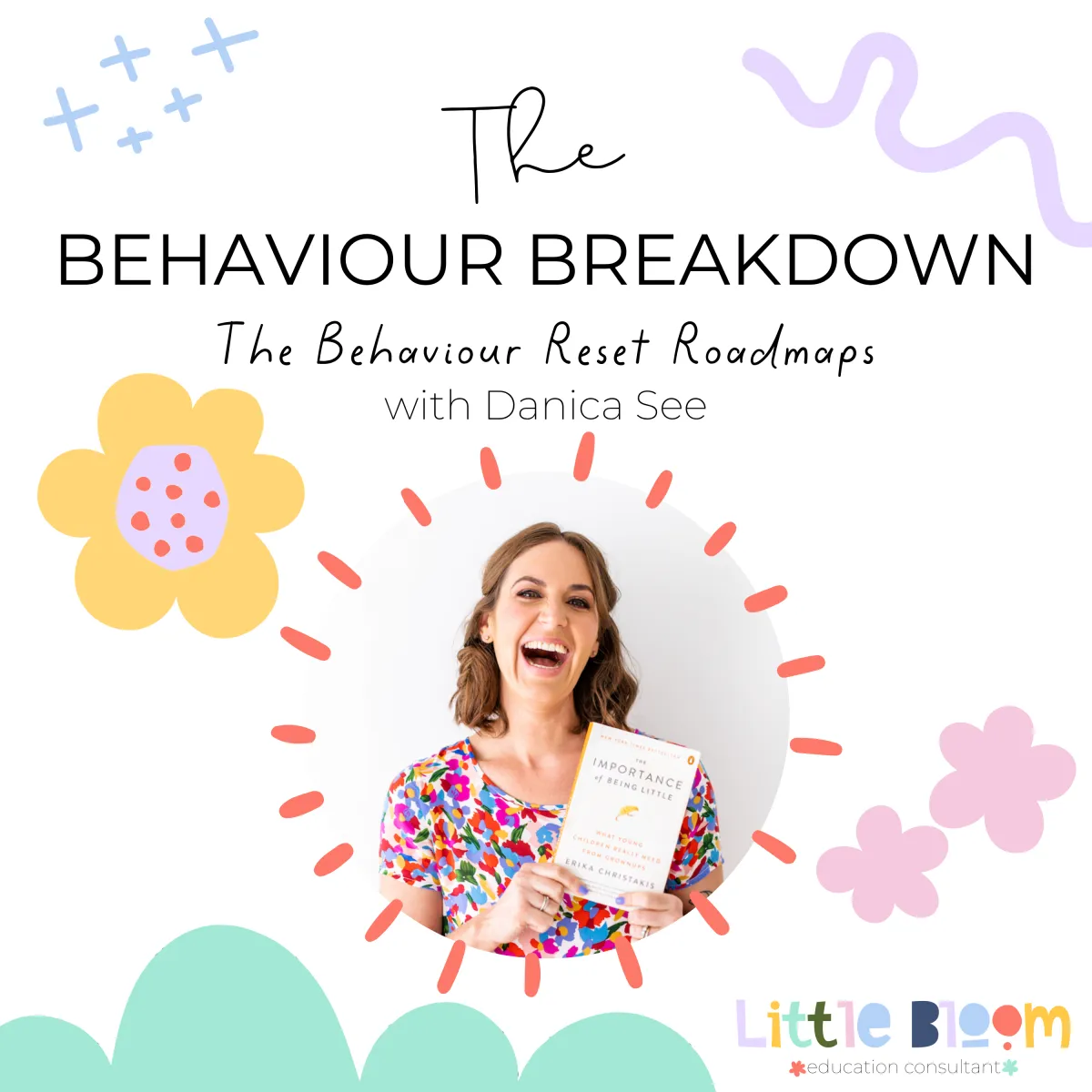
The Behaviour Breakdown: Your private podcast.
When a child says NO. When transitions turn chaotic. When someone bites another child.
Let's get into what behaviour support actually looks like in those moments!
Inside this exclusive podcast, I break down real-world behaviour scenarios using the Behaviour Reset Framework. We'll look at what might be driving the behaviour, what we need to consider, and how to think through an appropriate response.
I don't just want you to understand the framework; I want you to USE it.

Five bonus Behaviour Bites mini guides.
You'll also receive five practical mini guides to complement your learning:
When Mat Times Just Aren't Working: Connection-first strategies to rethink group times.
The Drivers Beneath Behaviour: Explore the factors influencing the behaviour you're seeing.
The Up/Down Regulation Toolkit: Movement-based strategies to support children's regulation.
When You Don't Know What to Say: Scripts to draw on in tricky behaviour moments.
The Reflective Reset: A guided tool for reflecting on your responses and deciding what to do differently.
These guides aren't a replacement for the deeper work inside the course; they're extra tools to help you put that learning into practice.

meet your mentor
Hi !
I'm Danica
Early childhood educator.
University lecturer.
Behaviour nerd.
Mama of two.
Lover of cinnamon scrolls and oat flat whites.
Big believer that we can do better by children AND educators.
I've spent over 17 years teaching children, mentoring educators, and digging into the research behind behaviour.
I've written and taught university-level behaviour units, and I'm still teaching a three-year-old pre-kindy class today.
I'm not teaching this stuff from the sidelines. I'm right there in the classroom with you.
What I've learned is that most educators genuinely want to do right by children, but there's a BIG gap between what we're taught about respectful behaviour support and knowing how to actually put it into practice.
That's why I created The Behaviour Reset.
To bring the research, the practical strategies and the deeper thinking together, so you can stop trying to piece it all together yourself.
I'd bloody love to have you inside.
Danica x
meet your mentor
Hi !
I'm Danica
Early childhood educator.
University lecturer.
Behaviour nerd.
Mama of two.
Lover of cinnamon scrolls and oat flat whites.
Big believer that we can do better by children AND educators.
I've spent over 17 years teaching children, mentoring educators, and digging into the research behind behaviour. In that time, I've written and taught university-level behaviour units, and I'm still teaching a three-year-old pre-kindy class today.
I'm not teaching this stuff from the sidelines. I'm right there in the classroom with you.
What I've learned is that most educators genuinely want to do right by children, but there's a BIG gap between what we're taught about respectful behaviour support and knowing how to actually put it into practice.
That's why I created The Behaviour Reset.
To bring the research, the practical strategies and the deeper thinking together, so you can stop trying to piece it all together yourself.
I'd bloody love to have you inside.
Danica x
Don't just take my word for it - hear it from them.
✺
“Danica helped me feel confident in my practice and in my knowledge. She helped me talk through what was important in a classroom and how to bring it to life.”
Sheridan - Early Childhood Teacher
✺
“Danica went above and beyond to support me. She truly listened and gave advice that was grounded, practical, and responsive to my real needs.”
J - Parent
✺
"I'm constantly amazed by Danica's ability to decode the research, blend it with her own insights and obvious passion for the work she does, then communicate it in such a relatable way. The educators she supports are lucky to have her."
Jacquie - Psychologist
Join the waitlist for juicy bonuses and exclusive early access!
Are we made for each other?
Let's make sure The Behaviour Reset is what you're looking for.
You'll fit right in if...
✔️ You believe children deserve respectful, rights-based behaviour support, but you're not always sure how to put that into practice.
✔️ You're tired of collecting strategies and want to understand WHY behaviour happens and how to respond.
✔️ You're willing to reflect on your own beliefs, expectations and responses, even when that gets a little uncomfortable.
✔️ You want practical approaches that make sense for real children in real classrooms (not some imaginary world).
✔️ You're ready to put time into learning, unlearning and actually trying things differently.

You’re in the right place if…
✔ You’re an educator who cares deeply and wants to feel more grounded when supporting behaviour.
✔ You’re ready to move beyond surface-level strategies and into real understanding.
✔ You’re open to rethinking old approaches - even if it’s a little uncomfortable at first.
✔ You want a framework that aligns with your values and works in real-world classrooms.

This probably isn't your course if...
✘ You're looking for a magic script or strategy that will make children do what you want them to.
✘ You believe punishment and shame are necessary for children to learn how to behave.
✘ You want someone to tell you exactly what to do in every situation, without considering what's happening for the child.
✘ You're not interested in examining how your own approach might be contributing to the behaviour you're seeing.
✘ You’re looking for a course focused primarily on what to do after behaviour happens, rather than also looking at what we can put in place before things get hard.

Enrolment Options
Enrolment Options
Ready to reset the way you support behaviour?
Everything you need to work through The Behaviour Reset, from the first lesson to putting the framework into practice.
Here's what's included in your enrolment:
✔️ Six modules of learning across 12 weeks
✔️ A suggested weekly learning pathway and reflection emails
✔️ Module workbooks and practical resources
✔️ The Behaviour Breakdown private podcast
✔️ Five bonus Behaviour Bites guides
✔️ Access to The Behaviour Reset Crew private community
✔️ Certificate of Completion
✔️ A 14-day, no-questions-asked refund policy
3-MONTH PAYMENT PLAN
✺
3 monthly payments of
AU$147
Total AU$441
PAY IN FULL
✺
1 payment of
AU$397
TEAM PRICING
✺
Enquire about team pricing
Supporting a whole team? Discounted team packages are available for 3+ educators and include:
Full individual access for each participant
A custom workbook for team reflection + discussion
A recommended pathway tailored to your setting (if applicable)
Want your workplace to cover the cost?
If your service or school might fund your professional learning, email me at [email protected] and we'll work out the details.
Frequently Asked Questions
A few things you might be wondering...
Is this just another course full of strategies I've already tried?
Nope!
While you'll learn plenty of practical strategies, The Behaviour Reset goes much further.
You'll learn how to understand what's driving behaviour, recognise what children need, and make informed decisions about which approaches to use, when and why.
It's about knowing how to USE strategies, not simply collecting more of them.
What makes The Behaviour Reset different from other behaviour courses?
We start with how you understand behaviour, not how to make children comply.
The course brings together children's rights, child development, research and practical classroom strategies. And because I'm still teaching, everything is grounded in the realities of working with children.
What if other educators in my setting approach behaviour differently?
You don't need everyone around you to agree with your approach before you can start making changes. Module Six explores working with colleagues, families and other professionals, including how to advocate for children when the practices around you don't sit right.
Plus, completing this course will help you stand oh-so-strongly in your convictions and have the research to back why you do what you do.
How much time will I need each week?
Allow approximately 60–90 minutes a week across the 12 weeks.
You'll receive a suggested weekly learning pathway with lesson checklists, plus reflection emails to help you work through the content and apply it to your practice.
Need to move at a more considered pace? That's absolutely fine! There are built in checklists in each of the Module Workbooks to help you track your progress.
Do I get access to everything straight away?
You'll get immediate access to the course platform and your first module.
The remaining modules open every two weeks, giving you time to work through the learning and put it into practice. You can also revisit lessons that have already been released and work through them at a pace that suits you.
Is this only for early childhood educators?
The course is designed primarily for educators working with children aged 0–8 and applies to school-based, service-based, and home-based settings. For context, it's actually the approach I use with my children (2 + 7), as well as with my Pre-kindy class of 3-year-olds.
The principles can also be useful in other settings where adults are supporting children's behaviour, development and rights.
Will I receive a Certificate of Completion?
Absolutely yes! A Certificate of Completion will be sent once all lessons have been completed.
What if I enrol and realise the course isn't for me?
No issue. You have 14 days to request a full refund, no questions asked.
You can explore the platform, begin the learning and decide whether it's the right fit for you. If you decide it's not the right fit, email me at [email protected]
Oh, hey!
Fancy seeing you down here.
Let me be so for real with you.

You already know the kind of educator you want to be. Let's make it easier to show up as them.
You care about children, and you believe in supporting behaviour with understanding, warmth and respect - but knowing what you believe and knowing what to DO when things get hard are two very different things.
You shouldn't have to spend years piecing it all together yourself.
That's why I created The Behaviour Reset - as a way to understand what's happening, decide what matters, and work out what to do next.
To give you the knowledge, practical tools and framework I wish I'd had when I was finding my feet with behaviour support.
The hard moments won't disappear. I mean, children will keep behaving like children (the audacity!).
But you can learn to meet those moments with a much better understanding of what's happening, what matters, and what to do next.
I'd bloody love to help you get there.
Love Danica x
14-day refund policy | A$397 upfront or 3 payments of A$147